
From idea to advice
Just the beginning
Computers now speak our language
Large Language Models are a technological revolution. They're probably going to be even more impactful than the Web, as I wrote here.
On the surface, they’re a powerful knowledge tool. But that’s not exactly why they’ll change the world.
They'll change our lives because they’re ushering in a new computing paradigm. These tools can transform unstructured, human language input into precise, machine-friendly output. They bridge the gap between the grammar of our world (human language) and the grammar of our machines (code). Now, computer applications can work directly with human language, eliminating the need for traditional interfaces. And computer applications affect every industry, every country, every firm, every household.
For example—the first-order consequence—is that you can now go from text to code instantaneously. Take Cursor . It’s transforming programmers’ lives by letting them turn ideas into English text, which then updates their codebase automatically. One major interface is eliminated: the need for one or more people to type out lengthy, complex code.
Now, from text to code is just one type of model. The ultimate evolution would be from idea to action, instantaneously. Take Musk's Neuralink . Allegedly, a brain chip patient played chess by moving the cursor with his thoughts (article here ). Brain activity is translated directly into actions. Once again, key interfaces are removed—this time, the whole chain of arteries that supply blood to muscles, nerves, muscles themselves, fingers, mouse, keyboard... the list goes on...
Yes, I know—Neuralink is dystopian, to say the least. Rest assured, it’s still uncertain how much of their progress is real. But we’ve undeniably shifted from the realm of impossibility to the realm of possibility.

So, in our world, financial advice, can we get straight from idea to advice?
This is Vega's mission. We launched to remove interfaces. Every day, we work towards reducing the time and the number of actions required between an initial state and a final state:
- Initial State A: an individual or household has a financial goal (or challenge) and the advisor knows how to accomplish it (or solve it) because they have expertise, years of experience, wits, relationships, and products.
- Intermediary State B: numerous documents, people, software tools, and vendors are involved. Moving even $1 requires conversations within the team, exchanges with support infrastructures, documents shared internally and externally, coordination with asset managers and custodians, possibly even banks—and, of course, countless computer actions: clicks, drag-and-drops, paragraphs typed, and so on. I just picked a money/investment example. I could have picked a planning one.
- Final State C: the goal (or challenge) is accomplished (or solved).
From idea to advice means moving directly from State A to State C, without the friction of State B. It sounds ambitious—and, to be honest, State B will probably always be part of the process. But could we make State B ten times shorter than it is today? I think so. Compressing State B into just 10% of its current length is actually a hundred times less ambitious than building Neuralink. If Neuralink is within the realm of possibility, then Vega is just within reach.
So yes, from idea to advice *is* possible. Large Language Models can make this a reality. As my professor and mentor Robert C. Merton used to say about a completely different topic:
"It's not a matter of new science—only tough engineering"
Robert C. Merton (link here )
The other truth
I’ll also add: it’s a matter of business execution, and this is arguably harder than the engineering part. Which easy features should come first? What should the sequence look like once one has achieved early traction? How does one deliver enough value now—compressing State B down to 80% of what it was—so advisors trust one when one says the end goal is 10%, and it’ll take 10 years to get there?
The path
Vega Minds is not going to integrate with neuronal implant solutions to make from idea to advice happen for independent financial advisors. For one, no advisor would be excited about that idea today. And secondly, I don’t have the patience (or the energy) for a 30-year project.
But I do have the patience for a 10-year journey. And our goal is to truly compress State B. Your client wants clarity on their investments, you conceive a bucket strategy, they agree, and it’s done. No State B. You think they should allocate IRA dollars to an annuity for guaranteed income, you outline the steps, and—just as Cursor converts text into code—Vega converts your idea into execution. No State B.
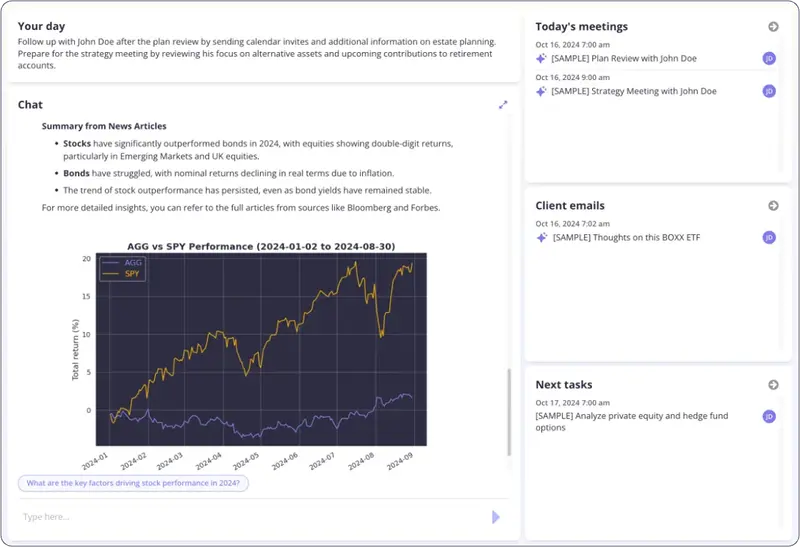
For the initial, straightforward features, we started with the basics: a meeting assistant, an email assistant, and a chat assistant. Initially, they operated independently, and the hit rate for each was low (hit rate meaning you get a good output for every input). Now, they’re integrating, and the hit rate is improving. The chat assistant is aware of your meetings and emails, the email assistant knows what happened in your previous meetings, and soon, your meeting follow-up emails will account for past emails and past meetings.
We’ve just released a simple dashboard to bring them together. It’s only step one—a beginning. Each piece that’s already in place needs to communicate even better with the others. And additional key pieces will need to be integrated: first, portfolio accounting and performance reporting; second, the planning software; and third, the custodian.
This is just the beginning.
"Now this is not the end.
It is not even the beginning of the end.
But it is, perhaps,
the end of the beginning."
Winston Churchill, just after the British routed Rommel's forces at Alamein: this was the first significant defeat dealt to the Germans.